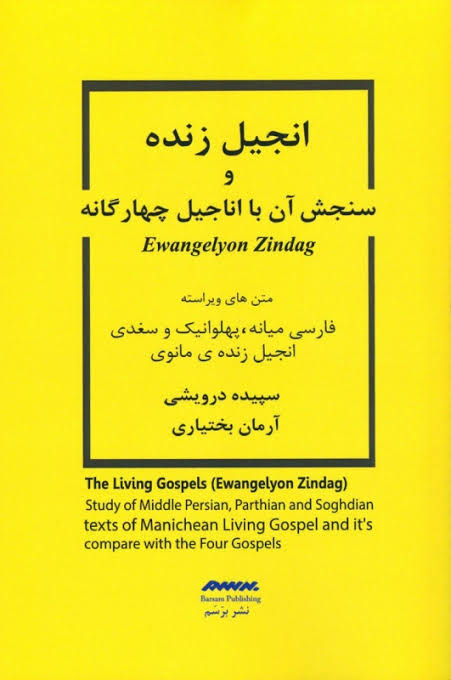
The Living Gospel and Its Comparison with the Four Gospels
The book The Living Gospel and Its Comparison with the Four Gospels is the result of a textual and comparative study of Mani’s Living Gospel. The original text has not survived as a complete, unified work; instead, portions of it have been preserved across different linguistic and manuscript traditions. The book was first published in 2018 by Barasm Publishing and has now reached its second edition.
In this study, I sought to move beyond a general account of Manichaeism and instead identify, classify, and examine the surviving fragments and evidence of the Living Gospel across a range of sources, bringing them together in order to develop a more precise picture of the structure and content of Mani’s work based on the available textual evidence.
The book examines evidence relating to the textual tradition of the Living Gospel in Middle Persian and Pahlavi, Parthian, Sogdian, Greek, and Coptic, placing these materials alongside surviving reports and quotations preserved in Islamic sources. This linguistic dispersion transforms the central problem of the research from a simple historical introduction into a study of textual transmission, translation, and reconstruction.
One important part of the research focuses on Manichaean vocabulary and terminology in the Middle Iranian languages and compares them with evidence preserved in the Greek and Coptic traditions. This comparison makes it possible to examine certain concepts and narrative structures of Mani’s Gospel not merely through secondary reports, but on the basis of evidence that survives directly from, or is closely connected to, the original text.
The comparative section of the book is devoted to examining this evidence alongside the four Gospels of the New Testament. It explores narrative and conceptual similarities, differences in the formulation of themes, characterization, the concept of Christ, salvation, cosmology, and the relationship between human beings and the material world.
For me, this book was an experience at the intersection of the history of religions, historical linguistics, Iranian studies, and manuscript studies. The central question was how, when the original text has been lost, its probable structure and content can be reconstructed from surviving fragments, translations, quotations, and scattered linguistic evidence, and then situated in relation to other texts from the same period and dealing with related subjects. The Living Gospel is the result of this attempt to read a lost text through the linguistic and historical traces it has left behind.